
Edinburgh by Numbers Report Shows City’s Health, Jobs and Visitor Spend
Edinburgh has recorded the highest employment rate among major UK cities, strong health figures, and £2.57 billion in visitor spend, according to the latest Edinburgh by Numbers report.
The annual city snapshot also points to pressure around housing, poverty, and population growth, giving a mixed but useful picture of where the capital stands in 2026.
Edinburgh’s latest annual data report has highlighted strong figures for health, jobs, tourism, transport, and green space, with the City of Edinburgh Council publishing details from the 19th edition of Edinburgh by Numbers on 21 May 2026.
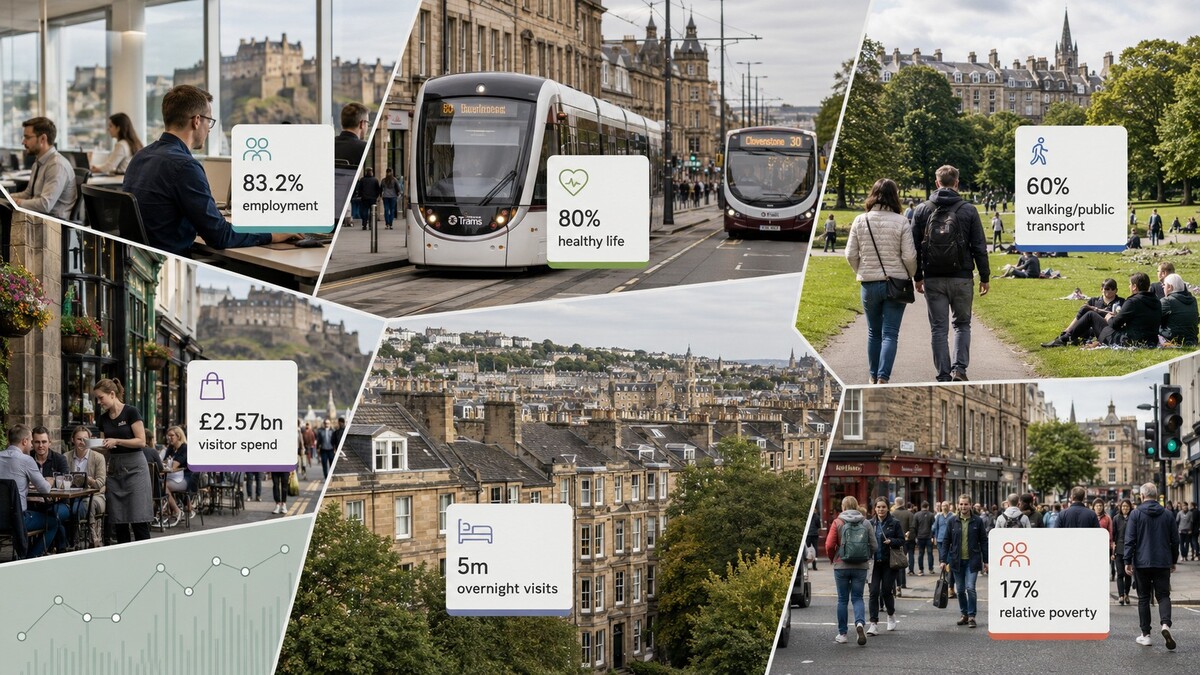
The report says Edinburgh has an employment rate of 83.2%, higher than all major UK cities included in the comparison, including London. It also found that people living in the capital spend around 80% of their lives in good health, the highest proportion of any Scottish city.
Key Edinburgh Figures at a Glance
| Area | Latest Figure |
|---|---|
| Employment rate | 83.2% |
| Life expectancy | 82 years for women, 78 years for men |
| Overnight visits in 2024 | 5 million |
| Visitor spend in 2024 | £2.57 billion |
| Visitor spend increase | Up 14.3% on 2023 |
| Residents in relative poverty | 17% |
| Population growth | Up 9.4% in the decade to 2024 |
| Trips made by walking or public transport | Around 60% |
| Residents satisfied with public transport | 86% |
| Green Flag parks | 36 |
For a broader look at the city, see our Edinburgh statistics guide.
Edinburgh’s Job Market Comes Out Strong
One of the clearest findings is Edinburgh’s employment rate. At 83.2%, the capital sits ahead of other major UK cities listed in the report.
The council says Edinburgh’s median hourly pay is £20.49, which is higher than comparable UK cities apart from London. That figure is also more than 50% above the UK Real Living Wage.
Those numbers fit with the wider picture of Edinburgh as a city with a large professional services base, a major public sector presence, strong universities, and a growing visitor economy.
The catch is familiar: high pay does not remove the pressure of high housing costs. The report notes that Edinburgh’s average property price is higher than major UK cities outside London, except Bristol.
Health Figures Are Strong, But Poverty Remains
The report says Edinburgh residents spend around 80% of their lives in good health, the highest proportion of any Scottish city.
Life expectancy also remains comparatively high, at 82 years for women and 78 years for men. The report adds that 86% of people take part in some kind of sport or fitness activity, including walking.
That does not mean the city is without sharp inequalities. Edinburgh by Numbers says 17% of residents live in relative poverty. That is below the national average of 21%, but still a large share of the city.
It is a useful reminder that Edinburgh’s strong headline figures sit alongside real pressure for many households, especially around housing, bills, and access to affordable areas of the city.
Tourism Spend Reached £2.57 Billion in 2024
Tourism remains a major part of Edinburgh’s economy. The report says the city attracted 5 million overnight visits in 2024, generating £2.57 billion in total visitor spend.
That spend was up 14.3% on 2023.
For a city that relies heavily on festivals, hotels, restaurants, pubs, attractions, taxis, tours, and cultural venues, the tourism figure matters. It shows the visitor economy has not just recovered, but is again a major force in local spending.
It also adds more context to the debate around Edinburgh’s planned visitor levy. The council has already linked tourism growth, housing demand, climate pressures, and city services as part of its longer-term planning.
You can read the full Edinburgh by Numbers report on the City of Edinburgh Council website.
Population Growth Is Adding Pressure
Edinburgh’s population grew by 9.4% in the decade leading up to 2024, compared with a national average of 4%.
The report says overseas migration is the main driver of that growth, with the net migratory effect more than ten times greater than the net effect of births and deaths.
Even with that growth, Edinburgh remains less dense than many comparable cities. The report puts Edinburgh at 2,015 residents per km², compared with 5,099 in Manchester and 4,755 in Sheffield.
That may sound surprising to anyone who has tried to find a flat in the city recently. Density is only one part of the story. Housing supply, demand, prices, short-term lets, student accommodation, and location all play into how tight the market feels on the ground.
Walking, Public Transport and Green Space Stand Out
Transport and public space are two of the brighter parts of the report.
Around 60% of trips in Edinburgh involve walking or public transport, while 68% of short journeys under two miles are made on foot or by bike.
Public transport satisfaction is also high. The report says 86% of residents are satisfied with public transport, more than 20 percentage points above the Scottish average.
Edinburgh also has 36 Green Flag parks. That is more than twice as many as Sheffield, which has the next highest number among the comparison cities.
Those figures back up something many people in Edinburgh already know: the city works best when you can walk it, use buses and trams, and get to decent green space without leaving the city.
Our Take
This is a positive report for Edinburgh, but not a simple “everything is fine” story.
The city is doing well on jobs, health, visitor spend, public transport, and green space. Those are real strengths, and they matter.
But the pressure points are just as real. Housing is expensive, the population is growing, and 17% of residents are still living in relative poverty. The most useful thing about Edinburgh by Numbers is that it puts both sides of the city in one place.
Edinburgh is healthy, busy, well-visited, and economically strong. It is also under strain. Both things can be true.