
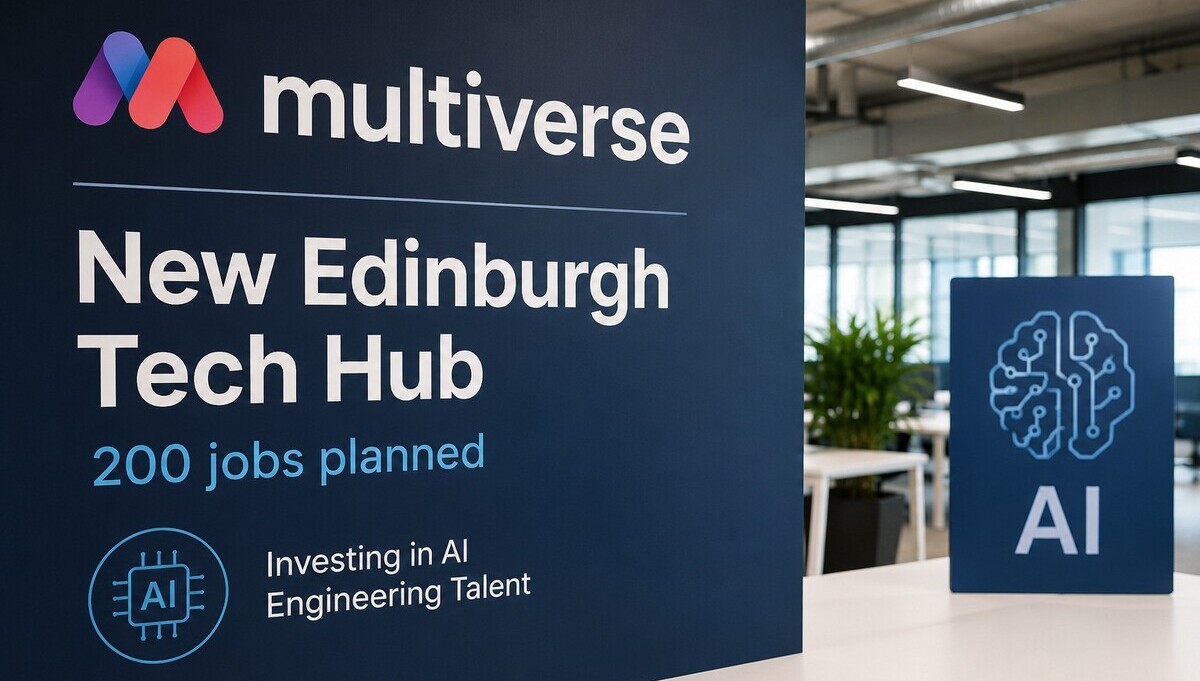
Multiverse Opens New Edinburgh Tech Hub As AI Firm Plans 200 Jobs
Multiverse has opened a new technology hub in Edinburgh as the AI upskilling company expands its engineering team outside London.
The company announced the new Edinburgh base in June 2026, with former Amazon leader Colin Mackenzie appointed as its first VP AI Engineering. Multiverse says it will create 200 jobs across its Edinburgh office and London headquarters over the next 12 months.
The move gives Edinburgh another notable name in its growing tech sector, with the new hub focused on AI product development and engineering talent.
Former Amazon Leader To Head Edinburgh Hub
Mackenzie joins Multiverse after six years at Amazon, where he worked on the generative AI platform behind the company’s AI advertising products.
Before Amazon, he held senior engineering roles at Virgin Money and Clydesdale Bank, worked on a startup exit, and founded his own business.
At Multiverse, he will lead the Edinburgh hub’s growth and work on agentic products, a term used for AI systems that can perform more complex tasks with less manual direction.
The company said he will also bring his experience into its AI talent development programme.
Why Edinburgh?
Multiverse said the Edinburgh hub gives the company access to “world-class engineering talent” in Scotland.
That isn’t a wild claim. Edinburgh already has a strong mix of universities, fintech firms, data companies, public sector technology work, and early-stage startups. The city is smaller than London, but its tech scene has become harder to ignore.
Mackenzie has also spoken about Edinburgh’s concentration of AI and engineering talent, pointing to the city’s universities and emerging companies as part of the reason for building there.
The new hub is intended to be more than a satellite office. Multiverse says the Edinburgh team will be integrated into the company’s wider engineering work, rather than sitting apart from the main business.
200 Jobs Planned Across Edinburgh And London
The jobs figure is one of the bigger local points in the announcement.
Multiverse says it plans to create 200 jobs over the next year across the new Edinburgh office and its London HQ. The company has not broken down exactly how many of those roles will be based in Edinburgh.
The hiring push follows a $70m funding round announced in May 2026. That investment was led by Schroders Capital, with backing from existing investors including General Catalyst, Lightspeed Venture Partners, D1 Capital Partners, Index Ventures, Bond, and StepStone Group.
Multiverse said the funding will support its expansion across Europe and help employers close skills gaps around AI, data, and digital work.
A Wider Push Into AI Skills
Multiverse works with employers on apprenticeships and workforce training, with a growing focus on AI and data skills.
The company has positioned itself around a clear argument: businesses are buying AI tools, but many workers don’t yet have the skills to use them properly.
That’s where the Edinburgh hub fits in. The new engineering team will help build AI products for employers, while the wider business continues to train staff in areas such as AI, data, and software engineering.
For smaller firms looking at the same challenge, Edinburgh SMEs can also access AI adoption support, with funding of up to £25,000 available for eligible projects.
The company has also said it will pair junior AI engineers with senior engineering leaders as part of an internal upskilling model. The idea is to build talent inside the business while developing the products it sells to employers.
What This Means For Edinburgh’s Tech Scene
For Edinburgh, the Multiverse announcement is another sign that the city is competing for serious tech work, not just smaller support teams or regional sales offices.
The capital already has a solid base in financial services, universities, gaming, data, software, and public sector tech. Adding more AI engineering roles helps strengthen that mix.
It may also help create more demand around the edges of the sector. Growing tech teams need recruiters, office space, designers, developers, marketing support, legal advice, cybersecurity support, and reliable digital infrastructure.
That last point matters for smaller local firms too. As more Edinburgh businesses become digital-first, the basics still count: fast websites, secure systems, and hosting that can cope when traffic jumps. For firms that have outgrown basic shared hosting, options such as a cheap VPS can sit between entry-level hosting and a much larger server setup.
It’s a small part of the bigger picture, but it’s the sort of practical tech decision more local businesses now have to make.
Our Take
This is a good win for Edinburgh.
The city does not need to pretend it’s London to build a serious tech sector. Its strength is different: strong universities, a compact business community, good quality of life, and a talent pool that already stretches across finance, data, software, and AI.
The real test will be how many of the promised jobs land in Edinburgh itself, and whether the hub becomes a proper centre of product and engineering work.
For now, Multiverse choosing Edinburgh for an AI engineering hub is a useful marker. It shows the city is firmly in the conversation when growing tech companies look beyond London.